
Quick answer: A physiotherapy website that actually books patients does five things well: it builds trust quickly, makes the path to booking obvious, answers the questions patients are really asking, works properly on a phone, and shows up in local search. This guide covers all five, written for UK clinics, with no filler and no invented statistics.
Your website is the first thing most patients see before they ever walk through your door. In the UK, the large majority of people search online before choosing a healthcare provider, which means your site is doing the work your reception used to do: making a first impression, answering questions, and turning interest into a booked appointment. Most physiotherapy websites are not built for that job. They look fine and do very little.
Here are the five things that separate a physiotherapy website that quietly brings in patients from one that just sits there.
1. Build Trust Fast, and Honestly
Patients choosing a physiotherapist are making a health decision, often while in pain or worried about a recovery. They are looking for reasons to trust you before they will book. A slick design alone does not do this any more. What builds trust is specificity and honesty.
What actually works:
- Real photos of your team and your clinic, not stock images of models in a generic treatment room
- A short video introduction from your practitioners, even one filmed on a phone, so patients can see who they will be treating
- Clear credentials stated plainly: HCPC registration, your areas of focus, years in practice
- Named, recent patient reviews that say what was actually treated, not anonymous five-star quotes
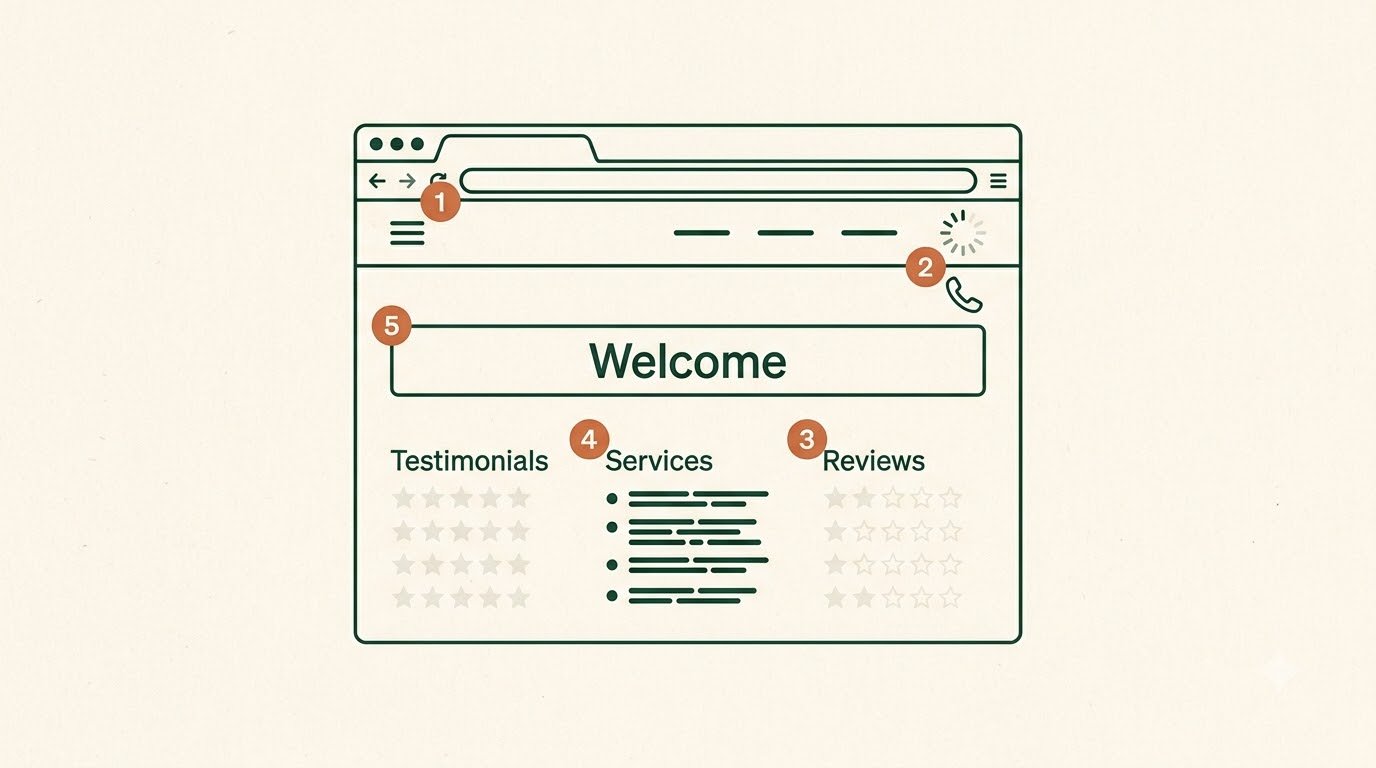
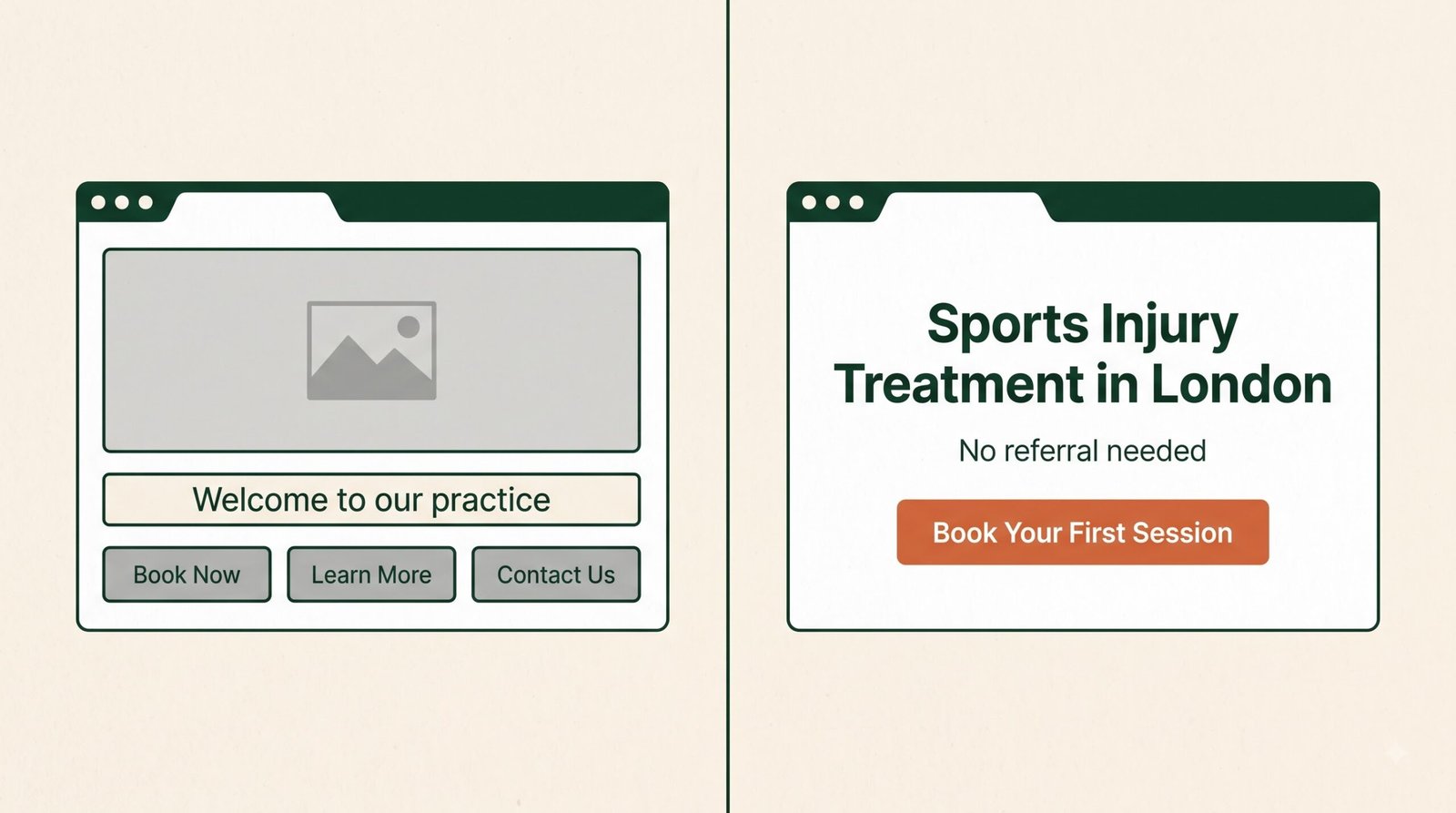
The pattern to avoid is the vague, decorative version of all this: “fully qualified and experienced,” three unnamed testimonials, a hero photo with no message. Specific claims are harder to write and much harder to scroll past without believing. That is exactly why they work.
For a fuller breakdown of what strong and weak trust signals look like side by side, see our guide on what separates a good physiotherapy website from a bad one.
2. Make the Path to Booking Obvious
Once a patient decides they are interested, your website should make booking the easiest thing on the page. Most clinic sites do the opposite: they bury the booking button in a menu, hide pricing entirely, and force a motivated patient to hunt for the next step. Every extra click is a chance for them to give up and go back to Google.
The parts that matter:
- Service descriptions written in plain language, not clinical jargon a patient would have to look up
- Clear pricing, or at least honest ranges, so patients know roughly what to expect before they enquire
- A booking button that is visible without scrolling, on every page, and clearly the most important thing to click
- Simple, obvious ways to get in touch for the patients who would rather ask a question first
Being open about pricing is worth singling out. A lot of UK clinics hide their prices, hoping to get the enquiry first. In practice, patients trust clinics that are upfront, and vague pricing tends to filter out fewer time-wasters than owners expect while quietly putting off serious patients who simply want to know what they are committing to.
3. Write Content That Genuinely Helps
Content on a physiotherapy website should not exist purely to feed search engines. It should answer the questions real patients ask, which is also, conveniently, what search engines now reward. The clinics that win here are the ones treating content as patient help first and SEO second.
A content approach that works:
- A dedicated page for each significant condition you treat, covering what it is, how treatment usually progresses, and what a first session involves
- Honest recovery timelines, so patients know what to expect rather than guessing
- Simple exercise or self-care guidance where appropriate, which builds trust before anyone books
- Real patient stories, with permission, showing the kind of outcome a new patient is hoping for
Quality beats volume every time. Ten thin, generic posts will do less for you than one genuinely useful page that answers a question properly. A single detailed page on, say, sports injury treatment will out-perform a bare services list that offers a search engine and a hesitant patient nothing to work with.
If you are still deciding on the site itself before worrying about content, our physiotherapy website design guide is the right place to start.
4. Get the Fundamentals Right on Mobile
Most patients will find you on their phone, often at the moment they are in discomfort and looking for help quickly. If your site is slow, awkward to navigate with a thumb, or clearly designed for a desktop first, you lose these patients before they ever see what you offer.
The features that make the difference:
- A genuinely mobile-first layout, not a desktop site squeezed onto a small screen
- Pages that load fast, ideally within about three seconds, because a large share of mobile visitors leave if they have to wait longer
- An online booking option that works smoothly on a phone, not one that breaks or demands endless typing
- Contact details and a booking button that are easy to reach with one thumb
This is not a nice-to-have. Google ranks mobile performance directly, and patients judge you on it instantly. A fast, simple mobile experience is now the baseline, not the differentiator. We cover what mobile-first really means for a clinic, including the one form field quietly costing you bookings, in our mobile-first design guide.
5. Show Up in Local Search
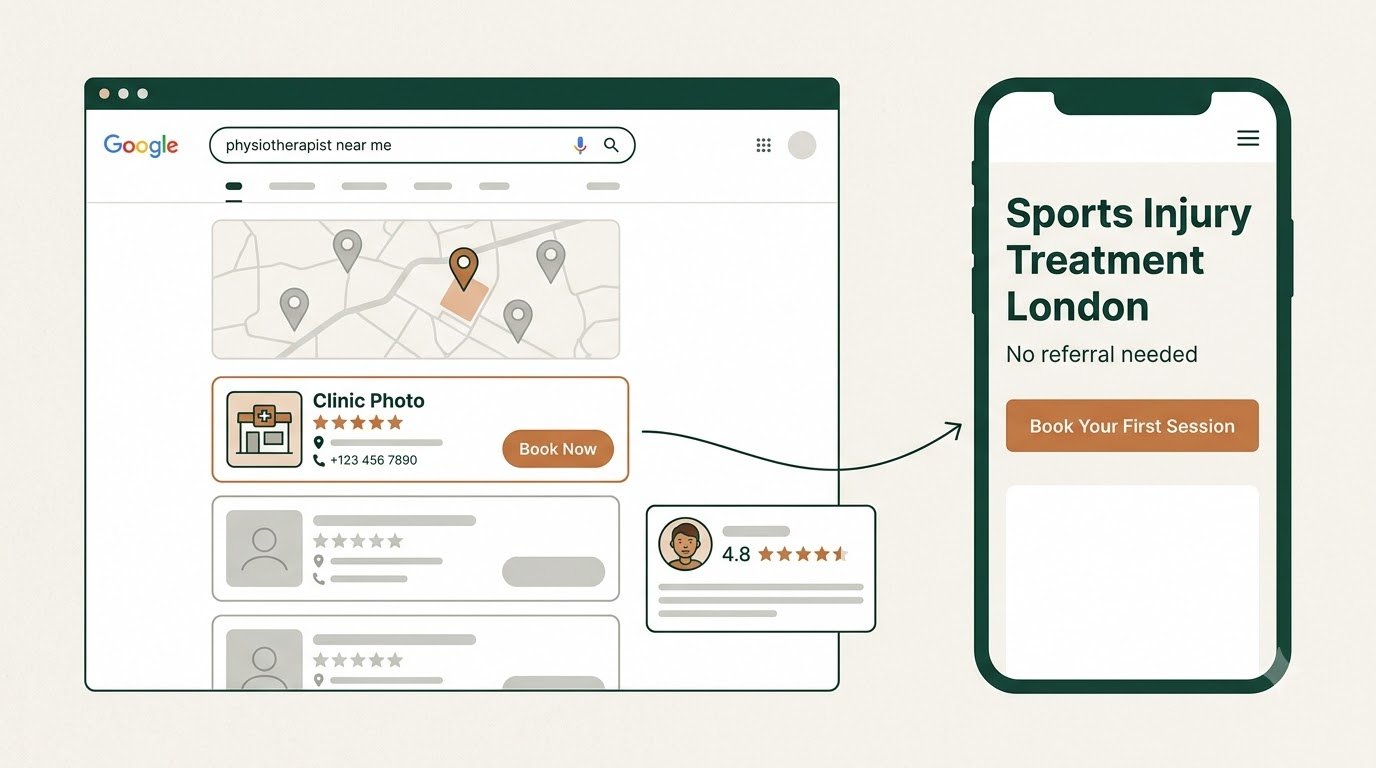
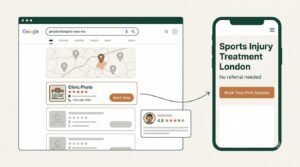
A physiotherapy clinic lives or dies on local visibility. When someone nearby searches “physiotherapist near me” or “physio in [your town],” you either appear in the local results or you do not. Local SEO is how you make sure you do, and it is one of the few areas where a small clinic can outrank much bigger competitors with steady, unglamorous effort.
Local SEO that works for UK clinics:
- A fully completed, actively maintained Google Business Profile with real photos and accurate information
- A steady flow of recent patient reviews, with a genuine reply to every one, positive or negative
- Location-specific pages if you serve more than one area, each clearly stating what you treat and where
- Consistent name, address, and phone number everywhere your clinic appears online, so Google is never seeing conflicting information
Nearly half of all Google searches have local intent, so for a clinic this is not a side project. It is one of the highest-return things you can do. Our local SEO guide for UK physiotherapy clinics covers the free fix most clinics have not touched in months.
What This Looks Like in Practice
You do not need to do all five at once. Trying to fix everything simultaneously usually produces mediocre results across the board. A more realistic order:
First few weeks: Sort the fundamentals. Make sure the site is fast and mobile-friendly, the booking button is obvious on every page, and your Google Business Profile is complete. These are the changes that move the needle fastest.
Next month or two: Build out your trust signals and your first condition-specific pages. Start asking satisfied patients for reviews, and reply to the ones you get.
Ongoing: Add content steadily, keep your Google profile active, and keep your reviews fresh. Local visibility and search rankings are the product of consistent upkeep, not a one-time push. This is exactly the work that quietly slips on most clinic websites once the initial build is done, which is the whole reason ongoing care exists.
How to Tell if It Is Working
Keep an eye on a small number of things that actually matter, rather than vanity metrics:
- New patient bookings and enquiries from the website
- The proportion of visitors who go on to book or get in touch
- Your visibility in local search for your key terms
- The recency and quality of your patient reviews
If those are trending up, the site is doing its job.
How PhysioWebCare Helps
Every website we build for a physiotherapy clinic starts from these five principles as the baseline, not an afterthought. If you want to see where your current site stands, our free physiotherapy website checklist walks through the fundamentals covered here in more detail.
If you would rather this was handled for you on an ongoing basis, so your site stays fast, current, and visible without you having to think about it, that is what our Grow plan is for.
It varies with scope, but our own plans give a realistic reference point: a professional launch build is £1,497 one-off, ongoing website care and growth is £597 per month, and a fuller AI-powered growth package is £1,197 per month. What matters more than the headline figure is whether the site actually converts visitors into patients, since a cheaper site that books patients is far better value than an expensive one that does not.
Treat the core design as something you revisit every couple of years, but the content and technical upkeep should be ongoing: fresh content regularly, plus routine maintenance and security checks. A site left untouched after launch slowly loses ground in search, which is the single most common problem we see on clinic websites.
Easy online booking, closely followed by mobile performance and clear, jargon-free service information. If a patient can find you, trust you, and book you in under a minute on their phone, the fundamentals are working.
You do not need a high-volume blog, but you do need content that answers the questions patients search for, especially detailed pages on the conditions you treat. One genuinely useful page is worth more than ten thin ones.
In most cases, yes. UK patients tend to trust clinics that are upfront about cost, and hiding pricing rarely filters out as many time-wasters as owners hope while putting off serious patients who simply want to know what they are committing to.
If you want a clear view of where your own site stands against these five principles, our free physiotherapy website checklist covers them in more detail, and our website design guide is the right next read if you are considering a rebuild.