How to Get More Patients From Google: The Complete Guide for UK Physiotherapy Clinics
Quick answer: Most physiotherapy patients in the UK start their search on Google. Whether they are searching “physiotherapist near me,” looking for treatment for a specific condition, or checking reviews before booking, Google controls the visibility that determines whether they find your clinic or a competitor’s. This guide covers the actual strategies that put your clinic in front of these patients at the exact moment they are searching for treatment.
Patients today do not flip through yellow pages or ask their GP for recommendations as their first step. They search on Google, check the map, read reviews, and often book their first appointment online without ever speaking to a receptionist. If your clinic is not showing up in these searches, you are not just missing patients. You are losing them to clinics that have optimized their Google presence.
The difference between a physiotherapy clinic that attracts a steady stream of patient enquiries from Google and one that struggles to fill appointment slots is not luck or location alone. It is a deliberate set of strategies that make your clinic visible and trustworthy at the moments people are actually searching for help.
Why Google is Crucial for Physiotherapy Patient Acquisition
Google is where the patient journey begins. Here is what matters:
- 46% of all Google searches have local intent, meaning the person doing the search is looking for something near their location. For a physiotherapy clinic, this translates directly to potential patients.
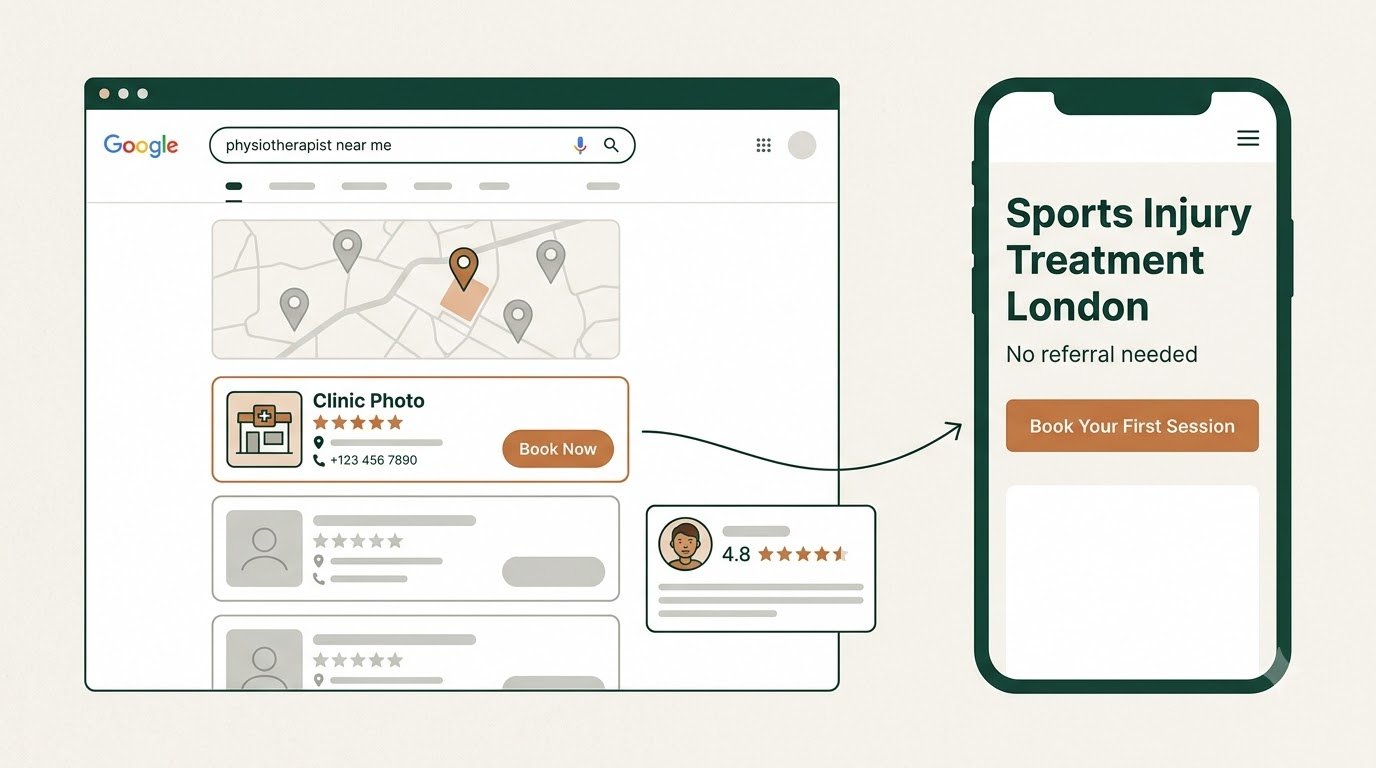
- Map visibility drives immediate action. When someone searches “physiotherapist in Manchester,” they see a map. Your clinic either appears in that top 3, or it does not.
- Review signals matter enormously. A clinic with authentic recent reviews ranks higher in Google’s local results and is significantly more likely to be chosen by a hesitant patient deciding between options.
- Search intent has shifted. Patients now search for specific conditions (“how to treat tennis elbow,” “sciatica pain relief near me”) before booking, not general terms. Your clinic needs to be discoverable for both broad and specific searches.
Without a solid Google presence, your referral partner networks, word of mouth, and NHS funding can only carry you so far. Google-driven patient acquisition scales.
The Four Channels That Drive Patient Acquisition From Google
1. Google Business Profile Optimisation
Your Google Business Profile is the single most important asset for a physiotherapy clinic. When someone searches for a physiotherapist in your area, Google shows your profile in the Map section and the local 3-pack. If your profile is incomplete, outdated, or poorly optimised, you are sending enquiries to your competitors instead.
Essential optimisations:
- Claim and verify your profile. If you have not claimed your Google Business Profile yet, do it now. It takes 10 minutes and is non-negotiable.
- Use the correct business category. Select “Physiotherapy Clinic” or “Physical Therapist” as your primary category. Secondary categories can include “Sports Medicine Clinic” or “Wellness Centre” if applicable.
- Complete your business information fully. Your address, phone number, website, and business hours must be accurate and match exactly everywhere else your clinic appears online (your website, directories, social media).
- Write a business description that speaks to patient needs. Do not write “We are a physiotherapy clinic providing physical therapy services.” Write something like “We treat sports injuries, back pain, and post-surgery rehabilitation for patients across Manchester. No referral needed. Online booking available.”
- Add high-quality photos. Include photos of your treatment room, reception area, and team. Patients want to know what to expect before they arrive. Aim for at least 10 photos, with good lighting and no clutter.
- Keep your profile current. Update your hours during holidays, add posts about special offers or new services, and respond to every review within 24 to 48 hours.
The impact: Clinics with fully optimised, regularly updated profiles see 30 to 50% higher click-through rates on Google Maps compared to clinics with sparse or outdated profiles.
2. Local SEO and Search Rankings
While your Google Business Profile handles map visibility, your website needs to rank in the organic search results for patients looking for information before they book. Local SEO is how you achieve this.
Local SEO fundamentals for physiotherapy clinics:
- Build location-specific pages. If you serve multiple areas, create a dedicated page for each major location you serve. A page called “Physiotherapy in Manchester” is more powerful than burying location information across a generic services page. Each page should clearly state what you treat and where you treat it.
- Target the keywords patients actually search. Patients search for “physiotherapist near me,” “back pain treatment Manchester,” “sports injury physio London,” and “ACL rehab [town name].” Your website content needs to match these search terms.
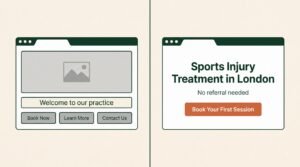
- Optimise your homepage for local search. Your homepage should mention your location in the headline or first paragraph. Google needs to understand immediately that you are a local business serving a specific area.
- Build local citations. Ensure your clinic appears in online directories and healthcare listings with consistent information. Services like Doctify, Treatwell, and Google itself rely on these citations to verify your business information.
- Ensure your address appears on every page. Your full business address should appear in your header or footer across all pages, not just on a contact page. This reinforces to Google that you are a local business.
The strategy: A physiotherapy clinic ranking on the first page of Google for “physiotherapist [town name]” and “physiotherapy [condition] near me” attracts a constant stream of enquiries from patients who are already searching for exactly what you offer.
3. Google Maps Ranking and the Local Pack
The “local pack” is the map that appears at the top of Google search results when someone searches for a local service. For physiotherapy, this is where most patient searches begin. Appearing in the top 3 of the local pack can mean the difference between filling your schedule and having empty slots.
How to rank higher in Google Maps:
- Complete your Google Business Profile fully. This is the primary signal. A 100% complete profile ranks higher than a 60% complete one.
- Generate consistent, recent reviews. Google’s algorithm favors clinics with regular new reviews from real patients. Ask satisfied patients to leave reviews on your Google Business Profile after their appointment. A clinic with 50 recent reviews will rank above a clinic with 10 old reviews, even in the same postcode.
- Respond to every review, positive and negative. Google sees this as a signal of active business management. A thoughtful response to a negative review can actually improve your ranking more than ignoring it does.
- Use Google Posts. Google Business Profile includes a “Posts” feature where you can share updates, special offers, or news. Posting twice a month signals to Google that your business is active.
- Get link signals from your website. Your website should link to your Google Business Profile. This reinforces the connection between your web presence and your local business listing.
- Ensure your business information matches everywhere. If your address is listed differently on your website versus your directories versus your social media, Google sees conflicting information and ranks you lower. Consistency matters.
Quick wins: Clinics that generate just 5 new reviews per month and respond to every review see measurable improvements in local pack rankings within 60 days.
4. Google Ads for Physiotherapy Clinics
While organic search and local SEO take time to build, Google Ads puts your clinic in front of searching patients immediately. For a physiotherapy clinic, this is often the fastest way to test whether your messaging works before investing in longer-term SEO work.
Google Ads strategies for physiotherapy:
- Target high-intent keywords. Bid on keywords where the search intent is clear and immediate: “physiotherapist near me,” “book physiotherapy appointment [town],” “back pain physio [area],” “same-day physiotherapy appointment.” These searches have high conversion potential because the person is ready to book.
- Use location targeting. Restrict your ads to your service area to avoid wasting budget on clicks from people too far away to visit.
- Write ads that remove hesitation. Your ad copy should address common barriers: “No referral needed,” “Online booking available,” “First consultation £45,” “Accept private insurance.” Make the next step obvious.
- Set up conversion tracking. Track form submissions, phone calls, and appointment bookings so you know which keywords actually drive business, not just clicks.
- Run retargeting campaigns. Show ads to people who visited your website but did not book. A second touchpoint often converts hesitant visitors into actual patients.
- Start small and test. Begin with a budget of £15 to £25 per day. Test different keywords and ad copy. Double down on what works.
The reality: A well-structured Google Ads campaign for a physiotherapy clinic typically costs £1 to £3 per qualified enquiry. If your average patient value is £500 to £2000 over a course of treatment, this is profitable from month one.
5. Organic Search: Ranking for Condition-Specific Searches
Beyond local search, patients search for specific conditions and how to treat them. A patient with tennis elbow might search “how to treat tennis elbow,” “tennis elbow physio,” or “tennis elbow treatment near me” before ever searching for a general physiotherapist. If your clinic has a dedicated, detailed page on tennis elbow treatment, you rank for these searches and attract patients actively looking for exactly what you offer.
Building organic search visibility:
- Create dedicated pages for conditions you treat. Each significant condition should have its own page covering what the condition is, how you treat it, recovery timelines, and patient stories. These pages rank higher than a generic services list.
- Answer the questions patients actually ask. Use tools like Google’s “People also ask” section to see what patients search for around your conditions. Answer these questions on your pages.
- Build internal links. Link from your homepage to your condition pages, from condition pages to your booking page, and from blog posts to both. Internal links help Google understand your site structure and distribute ranking power.
- Keep your content fresh. A blog post published five years ago ranks lower than a recently updated post on the same topic. If you have older content on a page, update it, add new examples, and refresh the publish date.
Content depth matters. A 300-word page on “back pain treatment” ranks lower than a 1500-word page that covers different types of back pain, treatment approaches, recovery timelines, and when to see a physiotherapist. Depth signals expertise to Google.
Common Mistakes That Kill Your Google Visibility
Incomplete Google Business Profile. The single most common mistake. Clinics leave their profile 50% complete, with no photos, no business hours, and no response to reviews. This immediately signals to Google that your business is not active.
Inconsistent business information. Your address, phone number, and business hours differ between your website, your Google Business Profile, and directory listings. Google penalises this inconsistency.
No reviews or very old reviews. A clinic with zero reviews or reviews from three years ago ranks lower than a clinic with regular new reviews. Patients also notice this and are more likely to book with a clinic that has recent, positive feedback.
Generic service pages instead of location or condition-specific pages. A page titled “Our Services” with a bullet list ranks far lower than dedicated pages for each location and condition.
Website built for desktop only, unusable on mobile. Google prioritises mobile-friendly websites. If your site is slow or hard to navigate on a phone, you rank lower and lose patients who search on mobile.
No clear call to action. Your website should make it obvious how to book an appointment. If the booking button is buried in a menu or hard to find, patients abandon the search and call a competitor instead.
Ignoring negative reviews. A clinic that ignores negative reviews (or worse, deletes them) sends a signal to Google and to potential patients that something is wrong. Responding thoughtfully to criticism shows maturity and commitment to improvement.
Building a Sustained Google Patient Acquisition Strategy
Most physiotherapy clinics approach Google as a one-time project: optimise the Google Business Profile once, write a few blog posts, then leave it. This does not work. Google visibility is the result of consistent effort over months.
Here is a realistic timeline:
- Month 1-2: Optimise your Google Business Profile fully, ensure your website is mobile-friendly and has clear booking options, set up Google Ads to start attracting enquiries immediately.
- Month 2-3: Build or rewrite your location and condition-specific pages. Start asking satisfied patients to leave reviews. Begin a blog or content schedule.
- Month 3-6: By now, you should see a measurable increase in enquiries from Google Ads and early organic rankings. Use this data to refine your strategy.
- Month 6-12: Organic search rankings improve. Your reviews accumulate. Your local pack visibility strengthens. Patient acquisition from Google becomes predictable and lower-cost.
The clinics that succeed are the ones that treat this as an ongoing program, not a one-off task.
How PhysioWebCare Approaches Google Patient Acquisition
Every physiotherapy website we build includes a foundation designed to make you visible and rankable on Google from day one. This includes:
- A fully optimised Google Business Profile with professional photos and complete business information
- Location-specific pages if you serve multiple areas
- Dedicated condition-specific pages with proper internal linking
- Mobile-responsive design that loads fast and converts visitors into bookings
- Schema markup that helps Google understand your clinic’s information
- A blog structure ready for ongoing content creation
We also provide access to our free physiotherapy website checklist, which covers Google visibility fundamentals in detail.
Our Grow plan includes ongoing optimisation: review management, content updates, and performance monitoring so your Google presence keeps improving month after month.
Frequently Asked Questions
Google Ads can drive enquiries within days. Organic search rankings take longer. Expect to see measurable improvement in local search rankings within 60 to 90 days if you have an optimised Google Business Profile and location-specific website pages. Full organic authority typically takes 6 to 12 months.
No. You can optimise your Google Business Profile yourself and implement basic SEO on your website without hiring anyone. However, most clinic owners lack the time, expertise, or patience to do this at a competitive level. An agency or specialist can accelerate your progress and help you avoid costly mistakes.
This varies widely. Organic search is essentially free once your site is built. Local pack visibility costs nothing beyond keeping your profile updated. Google Ads typically costs £1 to £3 per qualified enquiry depending on your area, competitiveness, and ad quality. Overall, Google-acquired patients are typically much cheaper than traditional advertising or other digital channels.
Start with Google Ads. It gives you immediate visibility and data about which keywords and messaging actually convert. Use this data to inform your organic strategy. Once organic search gains traction, you can reduce Ads spending and rely more on free organic traffic.
Even 5 to 10 recent reviews make a measurable difference. Start asking satisfied patients for reviews immediately. Consistency matters more than volume. A clinic with 10 reviews from the last 3 months ranks higher than a clinic with 50 reviews from 2 years ago.
Yes. You can rank in the local pack with a Google Business Profile alone. However, patients who click on your profile will be disappointed if you have no website. A simple website with your services, location, and booking information is now essential for converting clicks into appointments.
Yes. Most physiotherapy clinics do not aggressively maintain their Google presence. If your competitors have an outdated profile, few reviews, and no recent content, you can outrank them relatively quickly by building a better presence. Even if competitors are strong, local search is large enough that multiple clinics can rank well in the same area.
Google renamed Google My Business to Google Business Profile. If you have an old account, it is still called “My Business,” but it is the same service.
A complete, accurate, actively managed Google Business Profile with regular recent reviews. Everything else follows from this foundation.
Write for patients, not for Google. Your business description should clearly communicate what you do and who you help, using natural language. Keyword stuffing (overusing your target keywords) looks unprofessional and does not help ranking. Google is sophisticated enough to extract meaning without gimmicks.
If you want a clear view of where your clinic currently stands, our free website checklist includes the exact local SEO items covered in this guide, and our Grow plan handles local SEO management on an ongoing basis so it never quietly slips, the way it does on most clinic websites left unmanaged.
If you are earlier in the process and still deciding on your website itself, our physiotherapy website design guide is the right place to start first.