Why Your Physio Clinic Doesn’t Show Up When Patients Ask ChatGPT (and How to Fix It)
Quick answer: Most physiotherapy clinics are invisible to AI assistants like ChatGPT and Gemini because their websites lack the structured data, consistent business information, and clear content that these tools rely on to recommend a business. You can check whether your clinic is affected in under a minute, and every cause on this list has a fix.
A patient in Leeds pulls out their phone. Their back has been aching for a week. Instead of opening Google and scrolling through ten blue links, they open ChatGPT and type: “best physiotherapist near me for lower back pain.”
ChatGPT gives them two or three names. Not ten. Not a page of options to compare. Just a short, confident answer.
If your clinic isn’t one of those two or three names, you didn’t lose a click. You lost the patient entirely, and you never found out.
This is happening across the UK and Ireland right now, and most clinic owners have no idea it’s affecting them.
What Is AI Search, and Why Does It Matter for Physiotherapy Clinics?
AI search is when someone asks an AI assistant like ChatGPT, Google’s AI Overviews, Gemini, or Perplexity for a recommendation instead of typing a query into a traditional search engine. Rather than returning a list of links, the AI gives a direct, conversational answer. Often it names just two or three specific businesses.
For physiotherapy clinics, this matters because patient behaviour is shifting fast. People increasingly treat AI assistants as a first stop for recommendations, not just a chatbot for writing emails. When someone asks “who’s a good physio for a sports injury near me,” the AI usually is not searching the web live. It is drawing on patterns of trust it has already learned. Which businesses are consistently described the same way. Which ones show up in reviews and directories. Which websites are structured clearly enough for it to understand what the business actually does.
If your website was built for a human scrolling on a phone, but never structured for a machine trying to understand it, you are competing for patients using rules that no longer fully apply.
How Many Physiotherapy Clinics Actually Show Up in AI Search?
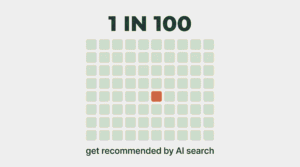
Very few. Independent analysis of local service businesses has found that only a small fraction, often cited around one in a hundred, ever get recommended by AI assistants for their category. The overwhelming majority are never mentioned at all, regardless of how good the clinic actually is.
This is not a physiotherapy-specific problem. It affects nearly every local service industry. But it hits physiotherapy particularly hard for one simple reason: private practice websites are frequently built by generalist web designers who have never been asked to think about AI visibility, because the client never knew to ask.
The clinics that do get recommended tend to share a few traits in common, and none of them are about being the best clinician in town. They are about being the clearest, most consistent, and most structured business online.
Why Most Physiotherapy Clinics Are Invisible to AI Search
There are five recurring reasons a physiotherapy website fails to appear when a patient asks an AI assistant for a recommendation.
Inconsistent business information across the web. If your clinic’s name, address, or phone number appears slightly differently on your website, Google Business Profile, and any directory listing, AI models treat this as a warning sign. They favour businesses that appear the same everywhere. Inconsistency looks like unreliable data.
No structured data on the website. Structured data, usually written in a format called schema markup, labels your website so a machine can understand it without guessing. A page that says “Sarah’s Physio Clinic, Leeds, open Monday to Friday” is readable to a human. Without schema markup behind it, an AI model has to infer the same information. Inference is far less reliable than a direct, labelled data point.
Thin or generic content. Many clinic websites describe services in a single vague paragraph. AI models are trained to extract clear, specific, well-organised answers. A page that never directly answers a real question, like “do you treat sports injuries without a referral,” gives the AI nothing solid to extract and repeat.
Few or inconsistent reviews. AI assistants weigh recent, detailed reviews heavily when deciding which local businesses to trust. A clinic with three reviews from four years ago sends a weaker signal than a clinic with a steady flow of recent, specific feedback.
A website that AI crawlers cannot properly read. Some websites unintentionally block the crawlers that AI companies use to understand a page. Others load content in a way that only a human browser can see properly. If the site is technically inaccessible, none of the content on it matters.
What Do ChatGPT, Gemini, and Google’s AI Actually Look For?
They are looking for the same handful of signals, even though each platform works slightly differently underneath.
- Structured data (schema markup). Clear, machine-readable labels for your business name, location, services, and opening hours.
- A complete, active Google Business Profile. Accurate categories, services listed, and regularly updated information.
- Consistent name, address, and phone number. The same details everywhere your clinic appears online, with no variations.
- Recent, specific reviews. Detailed feedback mentioning real services, not just star ratings.
- Content that answers real patient questions directly. Clear pages that state what you treat, how the process works, and what a first appointment looks like, written in plain language rather than marketing copy.
- Technical accessibility. A site that loads properly and does not block the crawlers these AI tools depend on.
Every one of these signals overlaps with good, honest SEO practice. There is no secret trick here. The clinics that show up in AI search are simply the ones that have done the unglamorous groundwork properly, not the ones that found a shortcut.
How to Check If Your Clinic Shows Up in AI Search Right Now
You can test this yourself in a few minutes, with no tools required.
- Open ChatGPT, Gemini, or another AI assistant in a private or incognito browser window, so it is not personalising results based on your history.
- Ask it a question exactly the way a patient would, such as “best physiotherapist in [your town] for back pain” or “physio clinic near me that treats sports injuries.”
- Read the answer carefully. Note whether your clinic is mentioned, and if it is not, note which clinics are.
- Repeat this with two or three different phrasings, since AI answers can vary depending on how a question is asked.
If your clinic never appears, the good news is that the cause is almost always fixable, and none of it requires becoming a bigger clinic or a better clinician. It requires becoming a clearer, more structured, more consistent one online.
We built a free tool that runs this exact check automatically, sending real patient-style questions to ChatGPT and Gemini, then scanning your site for the technical and structural issues above. You can run it on your own clinic at no cost, and it gives you a full report rather than a yes or no answer.
How to Fix AI Visibility for a Physiotherapy Clinic
Once you know where the gaps are, the fixes follow a fairly consistent order of priority.
- Audit and correct your business information everywhere it appears. Your website, Google Business Profile, and any directory listing should show the exact same name, address, and phone number, with no exceptions.
- Add proper schema markup to your website. At minimum, this should cover your business type, location, services, and opening hours, written in a format machines can read directly rather than infer.
- Rewrite thin service pages into clear, specific answers. Instead of one vague paragraph about “comprehensive physiotherapy services,” write pages that directly answer real questions patients ask, such as what conditions you treat and whether a referral is required.
- Build a steady flow of recent, detailed reviews. Ask patients to mention the specific treatment or service they received, not just leave a star rating.
- Confirm your site is technically accessible. Check that AI crawlers are not being blocked and that your key pages load quickly and cleanly.
- Recheck your AI visibility every few months. AI models update frequently, and a fix that works today can lose its effect if a page goes stale or a competitor improves theirs.
None of this is a one-off task with a permanent result. Clinics that stay visible tend to treat it the same way they treat their Google Business Profile, as something reviewed and refreshed regularly, not something set up once and forgotten.
If you want to see exactly where your own clinic stands, run it through our free AI Visibility Checker. It takes about a minute, checks your clinic against ChatGPT and Gemini using real patient-style questions, and gives you a full report you can keep.
If your website has other issues alongside AI visibility, our free guide, Top 10 Website Mistakes Physiotherapists Make, covers the most common problems quietly costing clinics trust and enquiries.
And if you would rather talk it through directly, book a free 20-minute call. We will look at your clinic’s current visibility together and tell you exactly what we would fix first.