
Local SEO for UK Physiotherapy Clinics: 2026 Guide
Quick answer: Local SEO is how your clinic shows up when someone nearby searches for a physio, whether that is Google’s Local Pack, Google Maps, or a plain search results page. For a physiotherapy clinic, it usually matters more than general SEO, because almost every patient search carries a location, and Google now treats a complete, active Google Business Profile as the foundation everything else builds on. Get that right first, then build outward from it.
A patient with a sore shoulder does not search “physiotherapy.” They search “physio near me” or “physiotherapist in Leeds.” That single word, near me, changes everything about how Google decides who to show them, and it is why local SEO deserves its own strategy rather than being treated as a footnote inside general SEO advice.
This guide covers what actually moves the needle for a UK physiotherapy clinic specifically, based on current search behaviour data and what we have seen work across the clinics we build and manage websites for.
What Is Local SEO, and Why Does It Matter More for a Physio Clinic?
Local SEO is the practice of improving how a business appears in location-based search results, the Local Pack, Google Maps, and local organic listings. It differs from general SEO because it weighs different signals: proximity, a complete business profile, consistent contact details across the web, and recent, genuine reviews, rather than purely backlinks and content depth.
For a physiotherapy clinic, this matters more than it does for many businesses because the intent behind the search is almost always immediate and local. Nobody searches for a physio in a city they do not live or work in. Nearly half of all Google searches now carry local intent, and for a service business like a clinic, that share is almost certainly higher still.
How Many Patients Are Actually Searching Locally?
The scale of local search is larger than most clinic owners assume, and the behaviour behind it is telling.
- Around 46% of all Google searches carry local intent
- Roughly three in four people who search locally on their phone visit a business within 24 hours of searching
- “Near me” style searches have grown dramatically over the past few years, now running into the billions each month across all categories
That last point matters specifically for physiotherapy. A patient searching “physio near me” is not idly browsing. They are in discomfort, they want treatment soon, and they will very likely book with whichever clinic looks credible and answers their search first. Local SEO is not a nice-to-have marketing channel for a clinic. It is closer to being the front door.
The Google Local Pack, and Why It Decides Who Gets the Enquiry
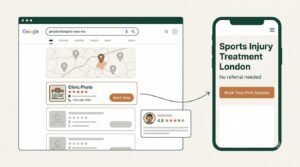
When someone searches “physio near me,” most will never scroll past the first screen. That screen is dominated by the Local Pack, the block of three businesses shown with a map, ratings, and contact details above the normal search results.
The Local Pack captures a large share of all clicks on a local search results page, and within the pack itself, the top three positions take the overwhelming majority of that traffic. Being fourth or fifth in local search results is, in practical terms, close to being invisible. This is different from general SEO, where ranking eighth on a page still generates some traffic. In local search, the gap between third and fourth place is enormous.

Your Google Business Profile Is the Single Highest-Leverage Thing You Can Fix
If you fix only one thing after reading this guide, fix your Google Business Profile. It is free, it is the primary input Google uses to decide who appears in the Local Pack, and most clinics have one that is incomplete, outdated, or has not been touched in months.
A complete, accurate, and actively maintained profile does several things at once:
- Signals to Google that your clinic is a real, trustworthy, currently operating business
- Gives Google the structured information it needs to match you against a search like “physio for back pain in Bristol”
- Builds trust with the patient directly, since a complete profile with real photos and services listed reads as far more credible than a bare listing
- Creates fresh signals over time, since profiles that go quiet for extended periods tend to lose visibility, a pattern that has become more pronounced as Google’s systems increasingly weigh recency
What “complete” actually means in practice:
- Every service you offer listed individually, not folded into one generic “physiotherapy” line
- Accurate, currently correct opening hours, including holiday changes
- A detailed business description that uses the language patients actually search, not internal clinical terminology
- Real photos of your clinic, your team, and your space, not stock imagery
- Regular posts, even briefly, since profiles that post regularly tend to appear more often in top local results
- Your website URL and booking link, kept current
Reviews: The Local SEO Factor Most Clinics Ignore
Reviews do two jobs at once. They are a ranking signal Google factors into local search, and they are the single biggest trust factor for a patient deciding between your clinic and the one next door.
Most consumers read reviews before choosing a local business, and the bar is not subtle. A clinic with a rating under four stars is meaningfully less likely to be considered at all, regardless of how good the treatment actually is. Quantity matters too. A clinic with a handful of reviews from years ago sends a far weaker signal than one with a steady, recent flow.
The part clinics overlook most is responding. Replying to reviews, including negative ones, is one of the few reputation actions with a directly measurable effect. A thoughtful, professional response to a critical review recovers a meaningful share of the trust that review would otherwise cost you, and patients notice when a clinic engages rather than stays silent.
A simple system beats an occasional effort here. Ask satisfied patients for a review as a normal part of your process, and reply to every review, good or bad, within a couple of days.
Beyond Google Business Profile: What Else Actually Moves the Needle
Google Business Profile is the foundation, not the whole strategy. Once it is genuinely complete, the next layer is:
- Consistent contact details everywhere. Your clinic’s name, address, and phone number should match exactly across your website, your Google Business Profile, and any directory listing. Inconsistency is treated as a trust problem, not a minor formatting issue.
- Location-specific content on your website. A generic “Our Services” page does less work than individual pages naming the town or area you serve, paired with the specific conditions you treat.
- UK directory listings, such as Yell, Thomson Local, and Bing Places, which reinforce the same consistent business information across the web.
- Genuinely local content, such as writing about a local sports club, a community event, or an area-specific health topic, which signals relevance beyond just stating a location.
None of this replaces Google Business Profile. It builds on it.

How Local SEO and AI Search Now Work Together
Local search and AI search are converging faster than most clinic owners realise. When someone asks ChatGPT or Google’s AI Overviews for a physio recommendation, the underlying trust signals are strikingly similar to what powers the Local Pack: a complete business profile, consistent information, and genuine reviews. A clinic that has done the local SEO work properly is already most of the way toward being visible in AI search too.
We have written a full breakdown of what AI search visibility means specifically and how to check where your clinic currently stands, which is worth reading alongside this guide rather than instead of it.
How to Check Where You Actually Stand
Before changing anything, it helps to know your starting point.
- Search “physio near me” and your specific treatment type from a private browser window, and see whether your clinic appears in the Local Pack at all
- Open your Google Business Profile and check when it was last updated, and whether every service is listed individually
- Count your reviews and check the date of the most recent one
- Search your own clinic name and confirm your address and phone number match exactly across your website and your profile
If most of these reveal gaps, that is normal, not a reason for concern. Local SEO responds relatively quickly to focused effort, and Google Business Profile improvements in particular can show measurable movement within weeks rather than months.

Frequently Asked Questions
Fixing Google Business Profile issues and building a steady flow of reviews typically shows measurable impact within two to three months. Less competitive local areas often see movement faster, since there are fewer well-optimised competing clinics to overtake.
For the Local Pack specifically, yes, since that is the primary input Google draws on for those results. Your website still matters for organic rankings beneath the pack and for converting the visitors who do click through, so the two work together rather than one replacing the other.
Not to get started. Claiming and properly completing your Google Business Profile costs nothing. Paid tools become useful once you are managing local SEO across multiple locations or want ongoing tracking, but a single-site clinic can do the fundamentals without any paid software.
There is no fixed number, but clinics with 50 or more recent reviews and a rating above 4.5 stars tend to have a meaningfully higher chance of appearing in top local results. Consistency matters more than hitting a specific total, a steady trickle of new reviews outperforms a large batch collected once and never repeated.
The Google Business Profile basics are genuinely doable yourself with an hour or two of focused effort. Where it gets harder is maintaining it consistently, building location-specific website content properly, and knowing which signals actually matter for a healthcare-adjacent business specifically, which is where a lot of clinics end up either neglecting it over time or paying for expertise.
If you want a clear view of where your clinic currently stands, our free website checklist includes the exact local SEO items covered in this guide, and our Grow plan handles local SEO management on an ongoing basis so it never quietly slips, the way it does on most clinic websites left unmanaged.
If you are earlier in the process and still deciding on your website itself, our physiotherapy website design guide is the right place to start first.