
Transforming Your Physiotherapy Website: From “Online Brochure” to Booking Machine
- Blog
- March 10, 2026

Most physiotherapy clinic owners believe their website’s primary job is to exist. They invest in professional photos and a list of services, then wonder why the phone isn’t ringing despite having decent traffic.
The reality? Most physiotherapy websites don’t have a traffic problem; they have a booking clarity problem.
If a potential patient lands on your site and can’t determine if you can fix their specific pain within five seconds, they will bounce back to Google and find your competitor. Here is a deep dive into the three critical issues plaguing physio sites today and how to fix them to increase your patient conversion rate.
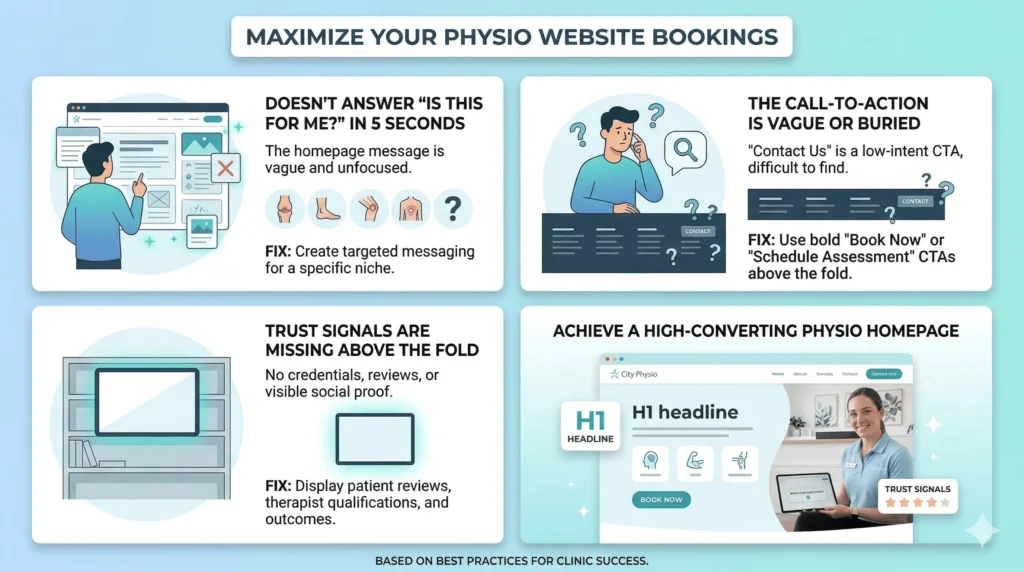
1. The “Five-Second” Clarity Test
The biggest mistake in healthcare marketing is trying to speak to everyone. When you attempt to treat every ailment from pediatric sports injuries to geriatric post-op care on a single homepage, your message becomes diluted.
The “Is This For Me?” Factor
When a user lands “above the fold” (the area visible without scrolling), they need an immediate answer to one question: “Does this clinic understand my specific pain?”
The Problem: Using generic headlines like “Quality Physiotherapy for the Whole Family.”
The Solution: Use niche-specific, benefit-driven headlines.
Bad: “Welcome to City Physio.”
Better: “Helping Runners in [City] Get Back on the Trail Without Surgery.”
SEO Pro-Tip: Use your primary keyword (e.g., Physiotherapy in [City Name]) in your H1 heading, but follow it immediately with a sub-headline that defines your niche.
2. Replacing Low-Intent CTAs with Direct Action
Many clinic websites hide their contact information or use “low-intent” calls-to-action (CTAs). If your main button says “Contact Us” or “Learn More,” you are asking the patient to do the heavy lifting of figuring out the next step.
Strategic CTA Placement
A high-converting physiotherapy website should guide the user toward a specific outcome.
Eliminate Vague Language: “Contact Us” feels like a chore. It implies a long form or a phone tag game.
Use High-Intent Phrasing: “Book Your Initial Assessment,” “Claim Your Discovery Call,” or “Check Availability.”
The “Sticky” Header: Ensure your primary booking button is always visible in the top right corner of your navigation menu, regardless of how far the user scrolls.
3. Front-Loading Trust Signals
Physiotherapists are some of the most qualified healthcare professionals, yet their websites often bury their credentials and success stories at the bottom of a “Staff” page. In the digital world, credibility must be instant.
Establishing Authority Above the Fold
Don’t make patients go looking for a reason to trust you. Incorporate these elements high up on your homepage:
Proof of Outcome: “Over 5,000 local patients helped” or “98% satisfaction rate.”
Recognized Qualifications: Display logos of your governing bodies or specialized certifications (e.g., OMPT, Sport Physio Canada, etc.).
The “Who We Help” Section: Use a simple grid of icons or images showing the types of patients you specialize in (e.g., Post-Surgical, Athletes, Chronic Back Pain).
Social Proof: A scrolling carousel of Google Reviews or a video testimonial works wonders for reducing “new-provider anxiety.”
The Shift Toward Specialized Patient Care
In 2026, patients are no longer looking for a “generalist.” As the NHS notes regarding physiotherapy services, patients typically seek help for very specific issues—whether it’s chronic pain management, sports injury recovery, or post-operative rehabilitation. If your homepage tries to speak to everyone at once, you miss the opportunity to prove you are the expert for their specific ailment. To stay ahead of the curve, your digital presence should reflect the top physical therapy trends of 2026, which emphasize value-based care and measurable outcomes. By narrowing your focus and highlighting your specialized results, you move from being just another option to being the only logical choice for that patient.
Why Conversion Rates Matter More Than Traffic
Many clinic owners obsess over getting more “hits” on their site, but data shows that traffic without clarity is a wasted investment. According to the latest healthcare marketing benchmarks, the average conversion rate for medical and health services is highly sensitive to trust signals and ease of booking. If your “Contact Us” button is buried or your credentials aren’t visible above the fold, you aren’t just losing a click; you’re losing a high-intent patient who was ready to book. In a competitive market, small optimizations to your user journey can be the difference between a stagnant schedule and a fully booked clinic.
Summary Checklist for a High-Converting Homepage
To audit your own site, ensure these 12 points are addressed:
| Category | Optimization Element |
| Messaging | Clear H1 with niche and location |
| Messaging | Benefits-led sub-headline |
| Navigation | “Book Now” button in the top right |
| Trust | Google Review rating visible (e.g., 4.9 Stars) |
| Trust | Accreditations/Logos visible without scrolling |
| Design | High-quality imagery of the actual clinic (not stock photos) |
| Content | Clear “Who we help” section |
| Content | Description of the “Patient Journey” (What happens next?) |
| Technical | Mobile-responsive design (Essential for local SEO) |
| Technical | Page load speed under 3 seconds |
| SEO | Meta titles and descriptions optimized for “Physio near me” |
| SEO | Internal links to specific service pages (e.g., Pelvic Health, Dry Needling) |
Take the Next Step
Your website should be your hardest-working employee, bringing in new bookings while you sleep. If your site feels more like a static business card than a growth tool, it’s time for a change.
Want the full 12-point Physio Homepage Checklist? I’ve developed a comprehensive guide to help clinic owners turn visitors into patients.
Click here to join our free Community and download the Checklist — We do weekly website teardowns and share data-driven strategies for physiotherapy marketing.
Frequently Asked Questions
Traditional metrics such as pageviews, sessions, and bounce rate only show how many people visited your website and how they moved around. They don’t show whether those visitors were potential patients, if they understood your services, or if they took meaningful actions like booking an appointment. For a physiotherapy clinic, success is measured in enquiries, bookings, and long-term patients, not just traffic numbers.
Beyond basic traffic, physiotherapy clinics should focus on KPIs such as:
- Percentage of visitors reaching key pages (services, conditions treated, booking, contact)
- Enquiry and appointment conversion rate by page or source
- Quality of leads (how many website enquiries become confirmed patients)
- Revenue and number of bookings influenced by the website
These KPIs show how effectively your website supports patient acquisition and clinic growth.
AI and automation can improve critical KPIs by:
- Answering common patient questions instantly via chatbots
- Guiding visitors towards the right treatment or service pages
- Capturing leads even outside clinic hours
- Supporting follow‑up sequences via email or messaging
This reduces admin workload and ensures more visitors convert into qualified enquiries and confirmed bookings.
Physiowebcare helps clinics turn their websites into growth‑focused digital assets. This includes:
- Designing or redesigning physiotherapy websites with clear patient journeys and strong calls‑to‑action
- Managing speed, security, updates, and technical health so your site is always reliable
- Setting up tracking, analytics, and KPIs that align with bookings and revenue
- Implementing AI and automation to capture, nurture, and convert more leads
The result is a website that doesn’t just look good—it actively contributes to your clinic’s appointments, revenue, and long‑term stability.
Google My Business is a critical asset, but it’s only one part of your online presence. Your website is where you tell your full story, build trust, and capture patients who want more information before calling. Google My Business drives traffic; your website converts that traffic into bookings.
Yes. Most care plans have month-to-month flexibility. That said, we recommend at least 3-6 months to see measurable improvements in rankings, traffic, and conversions. The longer you commit, the stronger the results.
Reports typically include: organic traffic analytics, conversion metrics (form submissions, calls, bookings), keyword rankings, site security status, page speed performance, and upcoming optimization recommendations. This keeps you informed and accountable.
Website care is focused on your site itself. However, a well-maintained website with fresh content and strong SEO provides excellent material for social media – blog post snippets, testimonials, case studies – creating a cohesive digital marketing presence.
Quick wins (speed improvements, security fixes, form optimization) are visible within 1–2 weeks. Medium-term results (organic traffic, search rankings) typically appear within 2–3 months. Long-term growth (established authority, consistent patient bookings) builds over 6–12 months.







Website and Digital Marketing Solutions for Physiotherapists and Cancer Rehabilitation Physiotherapists
Navigation
Contact Us
- info@physiowebcare.com
- Dharmanagar, North Tripura, India
- Click To Call Our Office