
From Pageviews to Profit: A New KPI Framework for Physiotherapy Websites That Actually Drives Patient Bookings
- Blog
- February 18, 2026
From Pageviews to Profit: A New KPI Framework for Physiotherapy Websites That Actually Drives Patient Bookings
Most physiotherapy clinics still judge their website by one question:
“How many visitors are we getting?”
That’s a good technical question.
But it’s a weak business question.
If you want your clinic to grow consistently, your website has to be more than “online marketing material.” It has to behave like a quiet, reliable growth engine that helps patients discover you, trust you, and book with you.
In this guide, we’ll walk through a new KPI framework that shifts your focus from pageviews to actual appointments, enquiries, and long-term revenue—designed specifically for physiotherapy and rehabilitation clinics.
Why Traditional Website Metrics Mislead Physiotherapy Clinics
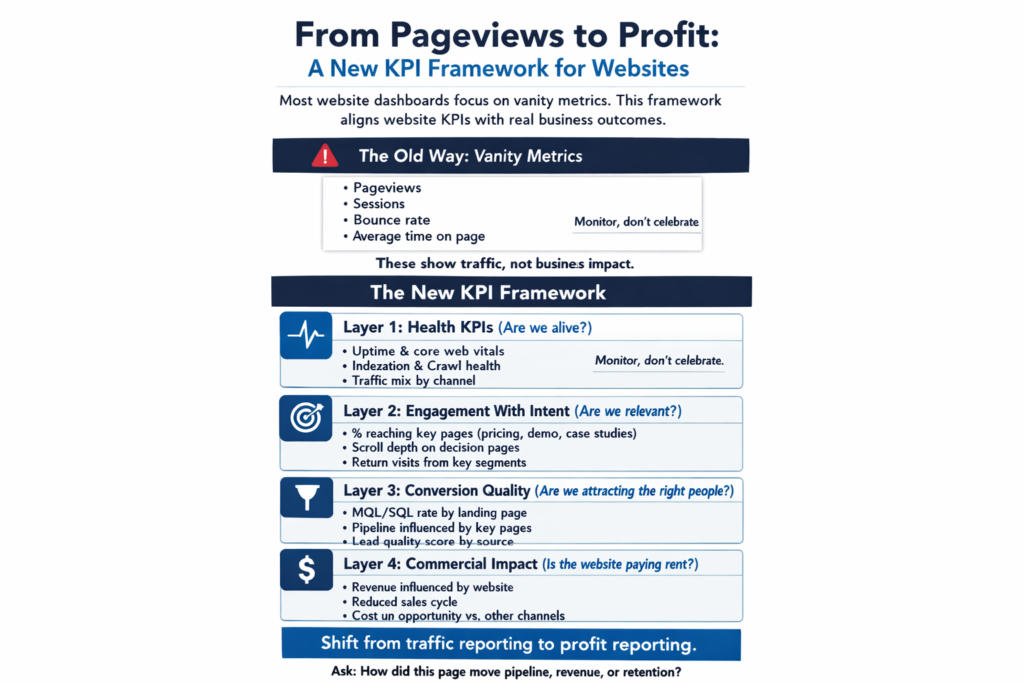
Most dashboards highlight:
- Pageviews
- Sessions
- Bounce rate
- Average time on page
These numbers tell you:
- Are people landing on the site?
- Are they browsing a bit?
But they don’t tell you:
- Are the right patients finding you?
- Are visitors actually booking an appointment?
- Is your website supporting your clinic’s revenue goals?
For a clinic, the real question is:
“Is my website quietly filling my calendar with the right patients?”
To answer that, you need a different way of looking at website performance.
The New KPI Framework: From Traffic to Treatment
At Physiowebcare, we don’t just design and manage websites for physiotherapists—we help them become future‑ready, conversion-focused digital assets.
Here’s the 4-layer KPI framework we use when we look at a physio clinic website.
Layer 1: Health KPIs – “Is the website alive and healthy?”
These are the technical foundations that keep your site functional and trustworthy.
Key Website Health KPIs:
- Uptime and reliability (is your site actually online?)
- Core Web Vitals and page speed (does it load fast on mobile?)
- Security status and backups (is patient data safe, is the site clean?)
- Indexation and crawl health (can Google easily understand your pages?)
These metrics don’t directly bring you more bookings—but without them, you lose trust, rankings, and enquiries silently.
At Physiowebcare, this is exactly what our website management for physiotherapy clinics focuses on: keeping your website fast, secure, updated, and quietly doing its job in the background so you can focus on treating patients.
Layer 2: Engagement With Intent – “Are the right visitors doing the right things?”
Not every visit is equal.
For a physiotherapy clinic, intent matters:
- Did they check your Services or Conditions You Treat?
- Did they visit Pricing, Location, or Contact pages?
- Did they scroll, read, and spend time where decisions are made?
Key Engagement KPIs for Physio Websites:
- Percentage of visitors reaching key decision pages (e.g. “Shoulder Pain Treatment”, “Cancer Rehabilitation”, “Book an Appointment”)
- Scroll depth on treatment pages (are they reading the important parts?)
- Clicks on key calls‑to‑action like “Book Now”, “Request a Call”, “WhatsApp”
- Return visits from local users (people who come back before deciding)
These metrics show you whether your content is relevant, trustworthy, and clear for patients who are actively looking for help.
Layer 3: Conversion Quality – “Are we attracting the right patients?”
Many clinics stop at counting form submissions or phone clicks.
But not every enquiry is equal.
Some are just price shoppers. Others are your perfect long‑term patients.
Important Conversion Quality KPIs:
- Appointment or enquiry rate by landing page
- Percentage of enquiries that turn into confirmed bookings
- Quality of leads by source (Google search, Google Business Profile, social media, referrals)
- Cancellation and no‑show rate for website‑generated bookings
When we work with clinics, we regularly look at which pages and which traffic sources bring in patients who:
- Show up consistently
- Complete treatment plans
- Leave positive reviews
- Refer friends and family
That’s where your real website ROI comes from.
Layer 4: Commercial Impact – “Is the website paying for itself?”
This is where your website steps into the role of a business asset, not just an expense.
For physiotherapy and rehab clinics, strong Commercial Impact KPIs include:
- Total number of confirmed appointments influenced by the website
- Revenue attributed to patients who first found you online
- Reduced admin time due to online forms, AI chatbots, and automation
- Cost per new patient when compared to offline marketing
- Increase in lifetime value from patients who discover more services through the site
With AI‑assisted tools and automation (like the ones we implement in our AI Growth for Physiotherapy Clinics service), your website can:
- Answer patient questions 24/7
- Guide visitors towards the right treatment
- Capture leads even when your front desk is busy
- Trigger email or WhatsApp follow‑ups automatically
All of that contributes directly to predictable, scalable clinic growth.
What Changes When You Start Measuring The Right KPIs
When physio clinics adopt this framework, a few important shifts happen:
They stop obsessing over “more traffic”
and start focusing on better patients per visit.Content moves from generic blogs to condition-specific, patient‑friendly pages that answer real questions and reduce fear.
Website design decisions are driven by the patient journey:
first symptom → reassurance → service page → proof/reviews → easy booking.Website reviews with their marketing partner move from:
“We had 2,000 visitors this month”
to
“Our website generated X new bookings and Y USD in projected revenue this month.”
This is the mindset behind everything we do at Physiowebcare: your website should be a quiet, consistent contributor to your clinic’s growth, not just a digital brochure.
How Physiowebcare Helps Clinics Move From Pageviews to Profit
If you’re a physiotherapist or cancer rehabilitation specialist, you don’t need more tools—you need a partner who:
- Designs a website that feels like your clinic and reflects your way of treating patients
- Manages speed, security, updates, and uptime so you never worry about the “tech side”
- Uses analytics and KPIs to guide improvements instead of random redesigns
- Adds AI and automation to reduce admin work and increase patient enquiries
That’s exactly what we offer through:
- Future‑ready physiotherapy website design
- Ongoing website management and care plans
- AI Growth for physiotherapy clinics – chatbots, automation, AI‑assisted content and SEO
A Simple First Step for Your Clinic This Month
If you want to start shifting from pageviews to profit:
- List your top 5 most visited pages.
- For each one, answer:
- What business outcome does this page support?
- How many enquiries or bookings did it influence last month?
- If you can’t connect a page to a meaningful KPI like bookings, enquiries, or retention…
it’s time to redesign its purpose.
If you’d like support reviewing your current website KPIs or planning a profit‑focused roadmap, you can explore our services or reach out through the contact form on Physiowebcare.com.
In Summary
- Traffic alone is not success – patient bookings and business stability are.
- A clear KPI framework turns your website into a measurable, improvable growth engine.
- Physiotherapy clinics that adopt this mindset consistently outperform those treating their website as a one‑time design project.
Frequently Asked Questions
Traditional metrics such as pageviews, sessions, and bounce rate only show how many people visited your website and how they moved around. They don’t show whether those visitors were potential patients, if they understood your services, or if they took meaningful actions like booking an appointment. For a physiotherapy clinic, success is measured in enquiries, bookings, and long-term patients, not just traffic numbers.
Beyond basic traffic, physiotherapy clinics should focus on KPIs such as:
- Percentage of visitors reaching key pages (services, conditions treated, booking, contact)
- Enquiry and appointment conversion rate by page or source
- Quality of leads (how many website enquiries become confirmed patients)
- Revenue and number of bookings influenced by the website
These KPIs show how effectively your website supports patient acquisition and clinic growth.
AI and automation can improve critical KPIs by:
- Answering common patient questions instantly via chatbots
- Guiding visitors towards the right treatment or service pages
- Capturing leads even outside clinic hours
- Supporting follow‑up sequences via email or messaging
This reduces admin workload and ensures more visitors convert into qualified enquiries and confirmed bookings.
Physiowebcare helps clinics turn their websites into growth‑focused digital assets. This includes:
- Designing or redesigning physiotherapy websites with clear patient journeys and strong calls‑to‑action
- Managing speed, security, updates, and technical health so your site is always reliable
- Setting up tracking, analytics, and KPIs that align with bookings and revenue
- Implementing AI and automation to capture, nurture, and convert more leads
The result is a website that doesn’t just look good—it actively contributes to your clinic’s appointments, revenue, and long‑term stability.
Google My Business is a critical asset, but it’s only one part of your online presence. Your website is where you tell your full story, build trust, and capture patients who want more information before calling. Google My Business drives traffic; your website converts that traffic into bookings.
Yes. Most care plans have month-to-month flexibility. That said, we recommend at least 3-6 months to see measurable improvements in rankings, traffic, and conversions. The longer you commit, the stronger the results.
Reports typically include: organic traffic analytics, conversion metrics (form submissions, calls, bookings), keyword rankings, site security status, page speed performance, and upcoming optimization recommendations. This keeps you informed and accountable.
Website care is focused on your site itself. However, a well-maintained website with fresh content and strong SEO provides excellent material for social media – blog post snippets, testimonials, case studies – creating a cohesive digital marketing presence.
Quick wins (speed improvements, security fixes, form optimization) are visible within 1–2 weeks. Medium-term results (organic traffic, search rankings) typically appear within 2–3 months. Long-term growth (established authority, consistent patient bookings) builds over 6–12 months.








Website and Digital Marketing Solutions for Physiotherapists and Cancer Rehabilitation Physiotherapists
Navigation
Contact Us
- info@physiowebcare.com
- Dharmanagar, North Tripura, India
- Click To Call Our Office